A SISTER OF THE TERRITORIAL FORCE NURSING SERVICE
*****
An Account by Isobel Jean Birrell
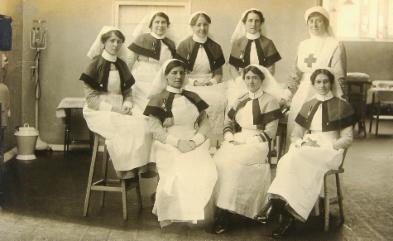
We arrived in France, January 3rd 1915, and were all detailed to different Hospitals. I was sent to a Base Hospital (all under canvas) at Rouen. I was very happy whilst there; we all loved our Matron, Miss Mark. The town of Rouen itself is such an interesting, historical, quaint old place.
After having been out about five months at this Base Hospital I had orders to get ready to go to a ‘Clearing Station,’ somewhere in Belgium – a new one. At last I felt my prayer had been answered especially when I was told that the Station was far up the line. Six of us were picked from different hospitals in Rouen, and all Territorials to make up a unit for this Clearing Station. In these days travelling by rail was difficult and slow. After a three day journey we landed at Hazebrouck, a small town almost on the Borders of Belgium. We got there about 4 a.m. feeling rather tired. The Unit we were attached to was for the time divided, the other half was in Belgium getting the new Clearing Station ready. Our Colonel decided we should stay in Hazebrouck and receive wounded there for the time being. Our ‘Clearing Station’ there was an old Lace Factory, a most insanitary place, - the usual French style, all windows air tight and which refused to open – it was terrible in these hot days. We were all very busy while there, we no sooner evacuated our wounded than another lot began to arrive.
Two days after our arrival at Hazebrouck we saw an encounter between one of our aeroplanes and a German Taube. It was a most exciting experience as it was the first we had seen. The Taube disappeared in a cloud which was rather disappointing. We could hear the thunder of the guns quite distinctly, but we were to be much more closely acquainted with them later. We had been in Hazebrouck about three weeks, when the Colonel gave our Sister-in-Charge orders to have us all in readiness for going to our Clearing Station. Shall I ever forget that day? We were all braced up for the event.
Belgium seemed so different from France with its picturesque windmills and hop fields and flat country well cultivated. We found our Clearing Station by the side of a railway just outside a Belgian town called Poperinghe. Poperinghe itself is between six and seven miles from Ypres. On our arrival we found wounded pouring in so we had to start at once to attend to our boys but first of all let me give you an idea of the Sisters’ ‘patch.’
Our grey tents were pitched in a kind of order in front of a farm. We had clover for our carpet and when the days got colder we had wooden floors put down. A small stream divided us from the Hospital part. We were able to receive between eight and nine hundred wounded and at a stretch took more. The Marquees were so nice and fresh after the Lace Factory – they were all painted a dark brown, to be like the colour of the earth and some variegated to imitate the foliage around so as to escape the vigilant eye of the German Taube.
In a short space of time our Clearing Station was in good working order. All abdominal operations were done with us thus saving hundreds of lives. My ward was nearly all abdominals. As our Padre said, we did God’s work up there. When I think of these boys being carried in wounded, aye wounded almost beyond all recognition, but smiling bravely to the last, it makes one feel proud to be British. There are memories of many little touching incidents which I shall cherish to my dying day. A common saying among our boys was “if you could only know how grand it is to be nursed in Belgium by someone from Homeland.”
Shall I ever forget the time of Loos? I was on night duty at the time. I had been on duty for an hour when the Sister-in-Charge said I was to be prepared for a large number of wounded during the night; as we were at the then busy part of the Line that was nothing unusual. About 1 a.m. the wounded simply poured in and every available space was packed outside as well as in, and rows of ambulances outside waiting to bring in more wounded – nothing but tartan and gore all round. The ambulance train removed the congestion at 4 a.m. As soon as we got one lot cleared out we started to receive immediately. Our orderlies were splendid and they worked that night with a will. Our Colonel was amazed to find in the morning that we had struggled through without any help. We were quite proud of the fact.
The Colonel at times used to worry about our being so far up the Line as the Germans shelled Poperinghe every second or third day. The whistling of the shells was at times fearsome, especially during the night. They landed sometimes on the railway just beside us, in a field beyond us and all round, which gave one a kind of uneasy feeling. But worse than the shelling was the bombing from the Taubes. They dropped gas bombs at times. The Colonel insisted on all of us having Gas Helmets always with us – we wore them strapped round the waist. One morning nine Taubes appeared and rained bombs all over our Clearing Station. It was a terrible time. One man was killed and some were wounded. One bomb dropped quite close to where I was standing – someone shouted “Lie flat” but my legs refused to obey me. I suppose it must have been fright. I was told the mud saved me. Our aeroplane chased them off. Two were brought down on the other side of Poperinghe. Next morning a German Taube was brought down just over our station. You should have heard the shouts of our men. The Marquees were very cold during the winter. We had braziers to heat them up but they were as often outside as in as they smoked terribly at times. Our Sister-in-Charge got the R.R.C. of which we were very proud, especially as we were all Territorials. I was eight months there and felt quite heart-broken at being removed to a Base again, as the work at a Clearing Station seems the work on went out to do.
Le Treport was quite a change from Poperinghe. The Hospital was one of the finest Hotels in France, standing high on a cliff above the sea, a magnificent building. Everyone was happy there. Our Matron, Miss Stronach took an individual interest in all her staff. I was sent from Le Treport to a very busy Stationary Hospital, Abbeville, in July, the time of the ‘Great Push.’ The hospital for the time being was turned into a Clearing Station. We were very short of staff there sometimes. I was on duty receiving patients till 12 midnight. It was a case of opening up new Marquees all the time. Patients were waiting in their ambulances to come in before we evacuated our old ones. We also got patients brought down on the Barges. They were always washed and wounds dressed which was such a help. Miss McCarthy, our Matron-in-Chief of the Expeditionary Forces Nursing Staff thanked us all for the manner in which we had tackled the work at a great time like that.
I was sent from there to a Clearing Station in the Somme District. The thunder of the guns was terrific all day and night; the whole surrounding Districts were lit up by the flashes. By going on a hill beside our Station we could see our trenches through a field glass quite plainly. We also saw shrapnel bursting like balls of fire over our lines, and liquid fire spreading along. It was a terrible sight – one I never went back to see. It was strange the Germans did not shell up when there. We had any amount of German wounded but they gave no trouble and were most grateful for everything that was done for them. Some of them looked on the verge of starvation. We had such an amount of our own poor boys sent in badly gassed while I was there. I was sent from Heilly to Calais, a Hospital situated between an ammunition factory and a Fort. We were all under canvas; it was a Territorial Hospital. I had quite an experience while there. We were awakened up one night about 12 midnight by the noise of guns and when looking out of my tent to see what the commotion was there was a Zeppelin right over the ammunition factory with all the searchlights playing on it and the aircraft going at it for all they were worth. We waited in trepidation not knowing what was going to happen next. The Zeppelin seemed to find things rather hot, for it went higher and higher pouring out a kind of black cloud all the time until it disappeared from sight. I was very sorry to leave Calais and my Matron, Miss Hardie, was quite vexed at my going.
My next move was on an ambulance train which was quite a change from my former work. The train was a French one but different in this way to the other French trains – a corridor ran through all the coaches excepting two on my end. The French ambulance trains were more suited to go to the part of the Somme District we had to go to. The Khaki trains were much too heavy and unable to take that part of the Line. There was so much mud around the Clearing Station that stretchers were put on trolleys and run on light railways with the wounded to the train. We always had a plentiful supply of German prisoners wounded. They all seemed glad and relieved to be out of such an Inferno. They were much astonished at the kindnesses they received. Some of them had lived in England and could talk English quite well. They more or less had an emaciated and half-starved look. I found them mannerly and grateful for all that was done for them. Some of them seemed to hate the Kaiser as much as we do.We were sometimes almost two days before we could dispose of our wounded at a Base, the reason being we had to stand aside to let troops and ammunition go on, big guns, etc. We saw some wonderful sights. A funny one was to see what seemed to us like huge sausages in the sky. These were between 20 and 30 observing balloons. Our C.O. on the train was just like a father to us – we were a nice little company.
I then returned to Rouen from where I started. I felt very sorry indeed to leave France as I had learnt to love the land and the people, however, I may again renew my acquaintance with them at a more peaceful date.
*****